

I was spending $320/month on groceries for ONE person. That’s insane.
So I tried to figure out how to save money on groceries without eating like a college student or giving up all flavor.
After 3 months of trial and error, I was able to lower my spending to $170/month. That’s a whopping $150 saved/month ($1,800 annually).
Here are my successes and my failures.
What I Was Doing Wrong (The $320/Month Mistakes)
I wanted to see the various ways I was spending money on groceries, so I tracked my groceries for a month prior to the savings.
What I found:
1. Shopping at expensive stores ($80/month wasted)
How I was shopping at Whole Foods for so long just because it was closest to my apartment is kind of ridiculous. I saved so much shopping at Aldi’s.
Whole Foods: $4.99 for a bag of spinach
Aldis: $1.79 for a bag of spinach
2. No meal prep ($60/month wasted)
I would spend a ton of money just buying a whole bunch of ingredients that I would later not have the skills to turn into a meal. Because of this, I would spend money on takeout, because I would complain, “I don’t have anything to eat.”
3. Everything was pre-cut ($45/month wasted)
Microwaveables, pre-cut, salad kits, and marinated meats. Sure, it was more convenient, but 2 to 3 times the value? No thanks.
4. Food waste ($35/month wasted)
Bought stuff that I never cooked. I probably wasted like $35/month in food that rotted, bread got moldy, and I threw away food.
Total waste: ~$220/month on stuff I could’ve avoided.
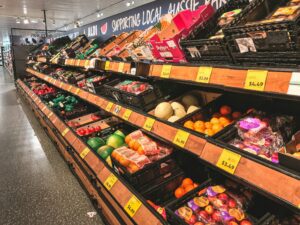
Strategy #1: Switched Stores (Saved $80/Month)
What I did: I went from Whole Foods to Aldi for 80% of my groceries.
Reality Check: Aldi doesn’t have everything. There are some things that I still pick up from regular grocery stores (specific brands, certain produce).
My current system: Aldi: 80% of groceries (basics, produce, meat, and dairy) Regular grocery store: 20% (specific items that Aldi doesn’t have)
Price Comparison (real examples)
| Item | Whole Foods | Aldi | Saved |
|---|---|---|---|
| Eggs (dozen) | $4.99 | $2.19 | $2.80 |
| Milk (gallon) | $5.29 | $2.85 | $2.44 |
| Chicken breast (lb) | $8.99 | $3.49 | $5.50 |
| Spinach (bag) | $4.99 | $1.79 | $3.20 |
| Bread (loaf) | $4.49 | $1.29 | $3.20 |
Just switching these 5 items = $17.14 saved per week = $68.56/month
Other cheap stores that worked:
- Walmart (cheaper than regular grocery stores)
- Costco (IF you can split bulk items with someone)
- Grocery Outlet (hit or miss, but good deals)
Saved $80/month
Strategy #2: Meal Planning (Saved $60/Month)
This one was annoying at first, but made the biggest impact.
What I do now (every Sunday):
- I plan five dinners for the week (needless to say, the same dinner often appears twice).
- I make a grocery list based only on those dinners.
- I shop only for the items on the list.
- I cook extra portions to make leftovers for lunch.
Example week:
- Monday/Tuesday: Chicken stir-fry with rice
- Wednesday/Thursday: Spaghetti with meat sauce
- Friday: Tacos
- Saturday: Leftovers or eat out
- Sunday: Meal prep for next week
Why this saves money:
Before: I used to order takeout ($40-60/week) after buying random stuff that didn’t make a complete meal.
After: I ate at home, rarely ordered out ($10-15/week) after buying only what I need.
Saved: $60/month (from reduced takeout + less food waste)
Strategy #3: Stop Buying Convenience Items (Saved $45/Month)
What I cut:
- Pre-cut vegetables ($4.99) → Buy whole, cut myself ($1.99)
- Pre-marinated meat ($9.99/lb) → Buy plain, marinate at home ($4.99/lb)
- Microwaveable rice cups ($2.49 each) → Buy rice bag, cook in bulk ($0.30 per serving)
- Bagged salad ($4.99) → Buy lettuce head ($1.49)
- Pre-made guacamole ($5.99) → Mash 2 avocados ($2.50)
Is this more work? Yes. Cutting vegetables now takes 10 extra minutes.
Is it worth $45/month? Yes! That’s $540 a year!
Strategy #4: Reduce Food Waste (Saved $35/Month)
What I changed:
1. Froze stuff immediately
Bought chicken on sale? Freeze half of it right away.
Bread going stale? Freeze it. Toast slices as needed.
2. Used “eat first” system
Put older food in front of the fridge. Newer stuff in back. Ate the old stuff first.
3. Made “leftover remix” meals
Leftover rice + frozen vegetables + egg = fried rice
Leftover chicken + tortilla + cheese = quesadilla
Before: Threw away $35/month in spoiled food
After: Maybe $5/month waste
Saved: $30/month
What Didn’t Work
Eating just the generic stuff is not economically savvy. It just ends up tasting worse.
Buying in bulk when living alone becomes an unwise choice. 7 lbs of potatoes just rot.
Eating just the beans and rice is also unsustainable.
Extreme couponing ended up with 3 hours of cutting coupons just to save $12.

Buying food in bulk was also a poor choice. I spent an unsavory amount of money just for 7 rotten lbs of potatoes.
Eating nothing but rice and beans sucks. But almost worse is how this is an unsustainable system. A made an unsavory amount of money and ended up with 7 lbs of potatoes that went rotten.
Eating nothing but beans and rice also just sucks. It spent an unsavory amount of money for 7 rotten lbs of potatoes.
Eating just beans and rice is also a despairing system.
Living literally without any food is also not economically wise. It just ends up tasting worse when the food is generic. Frugal living principles can significantly reduce food expenses without sacrificing quality.
Current Grocery Budget Breakdown ($170/Month)
Weekly shopping: $40-45
- Proteins (chicken, ground beef, eggs): $12-15
- Veggies: $8-10
- Carbs (rice, pasta, bread): $5-7
- Dairy (milk, cheese, yogurt): $6-8
- Fruits: $5-6
- Pantry (oil, spices): $4-5
Total: ~$170/month
Down from $320, making for $150/month savings = $1,800/year.
Is It Worth The Hustle?
Pros:
- Saving $150/month
- Healthier (cooking/home eating instead of takeout)
- Good relaxation from the stress of less food waste
Cons:
- Mea planning for 30 mins on some Sundays
- Vegetable cutting
- Less spontaneous food
For me: Worth it. $1,800/year can be a vacation or debt repayment.
For you: If you value time over savings, it may not be worth it.
Grocery spending is often where budgeting habits are tested the most.
Start Small (Don’t Overhaul Everything)
In the first month, just switch stores for Aldi or Walmart, yielding an easy $60-$80!
For month 2, start meal planning and save another $40-60.
For month 3, reduce convenience items and save an extra $20-40.
Each change makes a difference, and the sum adds up.

Feni. Personal Finance Writer & Budgeting Researcher
Feni focuses on practical budgeting systems, debt reduction strategies, and long-term financial stability. Her work combines real-life experience with research-based financial principles to create sustainable money habits rather than quick-fix solutions.
At ThriftVine, she shares structured, accessible guidance to help individuals build stronger financial foundations and make informed financial decisions.
The information shared on this website is for educational purposes only and should not be considered financial advice. Visit the About the Author page for more information.